
Reimagining physical education futures through a design thinking seminar
 christophe schnitzler
- lisa lefevre
- Fiona Chambers
Publié-e 2026-04-09
Mots-clés
- future studies,
- design fiction,
- education for sustainability,
- teacher education,
- scenario planning
Comment citer
© christophe schnitzler, lisa lefevre, Laura Cashman, Kelly Salchow Mc Arthur, Fiona Chambers 2026

Cette œuvre est sous licence Creative Commons Attribution 4.0 International.
Résumé
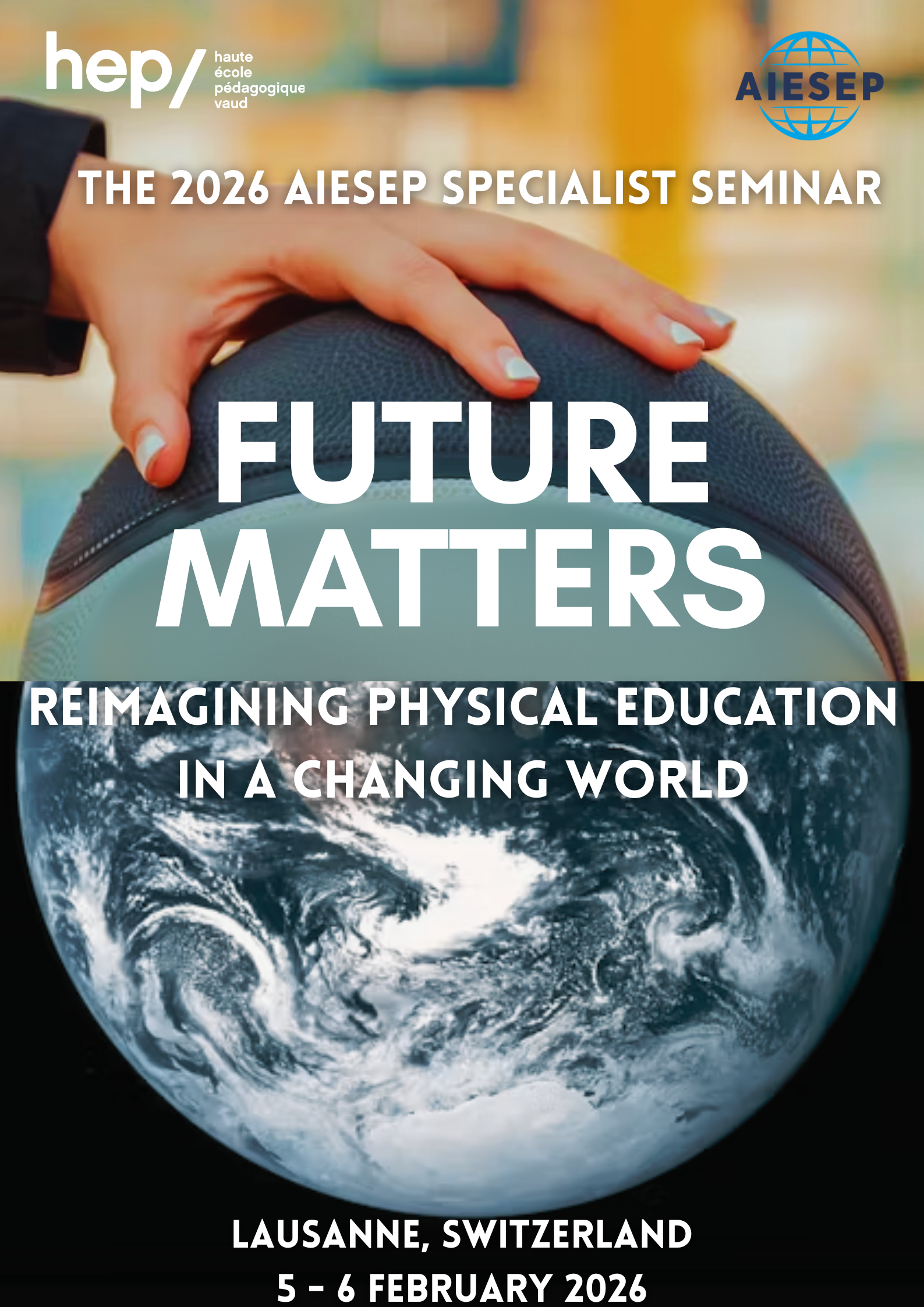
In an era defined by the profound ecological and social disruptions of the Anthropocene, all educational sectors are called upon to reimagine their purpose and practice. This article reports on a novel methodological approach to this challenge within the field of Physical Education (PE). It details the design and outcomes of the AIESEP Specialist Seminar, "Future Matters," which employed a design thinking framework to move from identifying planetary crises to prototyping actionable futures for PE. The article first establishes the theoretical imperative for this work, synthesising the concepts of the "Great Acceleration" and the Planetary Boundaries framework to argue for the urgent integration of Education for Sustainability (EfS) into PE. It then provides a detailed account of the seminar's methodology, which structured an anticipatory trial around four distinct, plausible futures derived from the ADEME[1] "Transition(s) 2050" scenarios (Frugal Generation, Regional Cooperation, Green Technologies, Restoration Gamble). We describe how participants used these scenarios and fictional personas to engage in a two-day design thinking "hackathon." The core of the article presents the results of this process: tangible prototypes for future PE, presented as narrative pitches. These prototypes include a community-based resource-sharing model, a collective decision-making tool for volatile environments, a transformative professional development program, and a human-centred application of low-cost technology. The discussion analyses these outcomes, highlighting emergent themes of agency, resilience, community, and critical pedagogy. We conclude that this structured, creative, and collaborative methodology offers a powerful and replicable process for educational fields to move beyond abstract critique and actively engage in the vital work of building preferable futures.